Last updated 2026-07-27
TL;DR
Compounded enclomiphene is generally stored refrigerated (36-46°F / 2-8°C), protected from light, and used within the beyond-use date your pharmacy assigns, often 90 days to 6 months for liquid preparations. Unopened vials from the pharmacy typically last longer if kept cold and dark. There's no FDA-approved product setting a standard shelf life, so always defer to the label your specific pharmacy prints.
How should you store enclomiphene between doses?
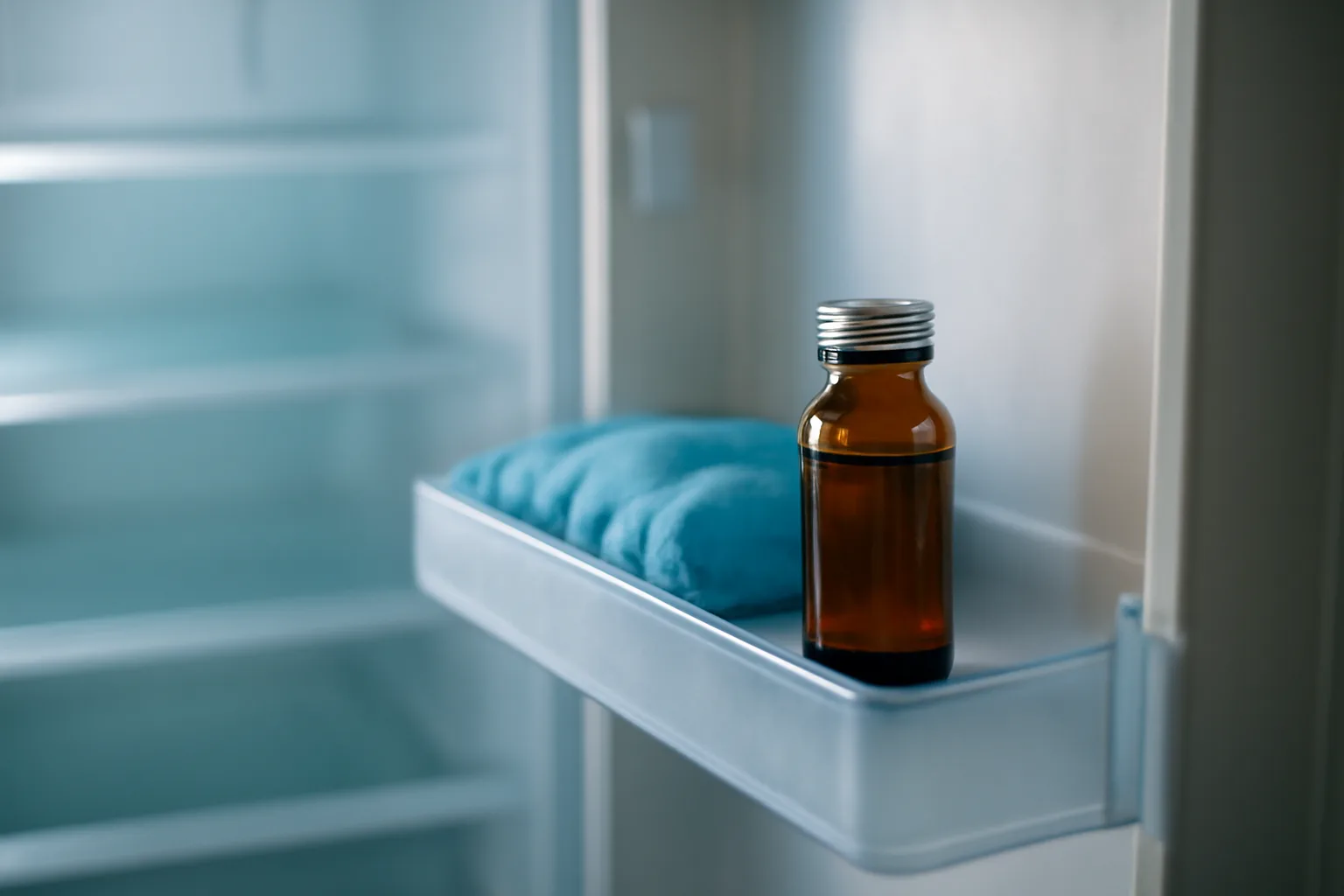
Keep the vial refrigerated, between 36°F and 46°F (2-8°C), in its original container, away from light. That's the standard instruction compounding pharmacies attach to most liquid SERM and peptide-adjacent preparations, and it lines up with USP General Chapter <795> guidance on nonsterile compounding storage conditions for controlled-room-temperature versus refrigerated preparations [1]. Don't freeze it. Freezing can crack glass vials and, more importantly, can destabilize the solution the compounding pharmacy formulated, whether that's an oil-based or aqueous carrier. If your enclomiphene ships in an oil suspension (some pharmacies compound it this way, similar to how they'd handle a testosterone cypionate base), cold temperatures can also cause the oil to thicken or the active ingredient to precipitate out. A quick warm-up in your palm or a 60-second sit on the counter before drawing a dose usually resolves that. If you're drawing doses regularly, this pairs with proper technique. See how to reconstitute Enclomiphene Direct and Enclomiphene Direct how to inject for the handling steps that go with storage.
How long does compounded enclomiphene actually last?
There's no single number, because enclomiphene has no FDA-approved commercial version with a manufacturer-tested shelf life. What you're getting is a compounded preparation, and its expiration (technically called a Beyond-Use Date, or BUD) is assigned by the compounding pharmacy based on USP <795> and <797> standards, not by a drug manufacturer's stability studies. For nonsterile, non-aqueous liquid formulations (oil-based), USP <795> allows a default BUD of up to 6 months from the date of compounding, provided the pharmacy hasn't run stability testing that supports something longer or shorter [1]. For water-containing (aqueous) formulations without preservative, the default drops sharply, often to 14 days refrigerated, unless the pharmacy has specific stability data supporting a longer date [1]. That's a big spread, and it's exactly why the printed date on your vial matters more than any generic answer online. In practice, most patients report their pharmacy prints a BUD somewhere between 90 days and 6 months for enclomiphene, consistent with the oil-based or non-aqueous default under USP <795>. But some pharmacies compound it as an aqueous solution, in which case the safe window is much shorter. Read your label. If it doesn't list a BUD, call the pharmacy and ask; a legitimate 503A or 503B compounding pharmacy will have this on file [2].
Does enclomiphene need refrigeration during shipping?
Reputable pharmacies ship enclomiphene with an ice pack or cold-chain packaging, especially in warm months, and most instruct you to refrigerate immediately on arrival. If a package sits on a porch in July for six hours, that's not ideal, but a few hours of ambient exposure during transit is a different risk profile than weeks of improper home storage. USP <795> allows controlled room temperature (68-77°F / 20-25°C) for many non-aqueous compounded preparations without automatically shortening the BUD, so brief warm exposure in transit isn't necessarily a disaster [1]. What actually degrades a SERM compound over time is repeated freeze-thaw cycling, prolonged light exposure, and extended heat (think: left in a hot car for days, or stored on a sunny windowsill for weeks). If your shipment arrived visibly warm or the ice pack was fully melted and the ambient temperature that week was extreme, it's reasonable to email the pharmacy and ask whether they want to reship rather than gamble on potency.
How can you tell if enclomiphene has gone bad?
Visually, look for cloudiness, unexpected color change (most enclomiphene solutions are clear to pale yellow), particulates floating in the liquid, or a cracked seal. Any of those is a discard-it signal, no exceptions. What you generally won't see is potency loss. Degraded SERM compounds don't typically turn visibly "off" the way spoiled food does; the API can lose potency due to hydrolysis or oxidation while the liquid still looks clear. That's the uncomfortable truth about self-monitoring compounded drugs: you're trusting the BUD and the pharmacy's process, not your own senses, for the potency question. This is one more reason sourcing from a pharmacy that does real stability-indicating testing (more than a guess) matters more than it might seem. If you're past the BUD and considering using it anyway: the honest answer is nobody has a great study telling you exactly how much potency you've lost at day 120 versus day 90 for this specific compound, because enclomiphene as a standalone product was never FDA-approved and so never went through the standard stability-testing pipeline a marketed drug would. The closest analog is clomiphene citrate (the enclomiphene/zuclomiphene mixture, marketed for decades as Clomid), which has an FDA-approved shelf life of 3 years for the intact tablet under proper storage per its approved labeling [3]. But that's a different molecule, different formulation, and a solid oral tablet, not a liquid injectable or capsule from a compounding pharmacy. Don't extrapolate that number onto your vial.
Why isn't there an FDA-set shelf life for enclomiphene?
Because enclomiphene citrate never made it through FDA approval as a standalone drug. The compound was developed under the brand name Androxal by Repros Therapeutics, intended as a treatment for secondary hypogonadism in men who wanted to preserve fertility, but the program did not reach FDA approval despite multiple Phase 3 trials [4]. What's approved and on the market instead is clomiphene citrate (brand name Clomid and generics), which is the racemic mixture of two isomers: enclomiphene (trans-clomiphene) and zuclomiphene (cis-clomiphene) [4]. Enclomiphene is the isomer thought to carry most of the anti-estrogenic, LH/FSH-stimulating activity at the hypothalamic-pituitary level; zuclomiphene has a longer half-life and is generally considered to contribute more estrogenic activity with less-understood effects on the axis [5]. Because enclomiphene alone isn't FDA-approved, what patients buy today is compounded by a 503A or 503B pharmacy under a doctor's prescription, using USP-grade active pharmaceutical ingredient. Compounding is legal and regulated (see FDA's guidance on human drug compounding under sections 503A and 503B of the Federal Food, Drug, and Cosmetic Act) , but it means shelf-life data comes from the compounding pharmacy's own stability protocols, not from an FDA-reviewed New Drug Application. That's the regulatory reality worth sitting with before you buy: you're trusting a pharmacy's quality process, not a federal approval, for both purity and expiration.
What's the difference between enclomiphene and clomiphene for storage purposes?
Clomiphene citrate (Clomid) is an FDA-approved tablet with a manufacturer-established shelf life, generally cited around 3 years when stored at controlled room temperature per the approved label, and it doesn't require refrigeration [3]. Enclomiphene, as a compounded liquid or capsule, is a different animal: shorter dating, often refrigeration-dependent, and the BUD varies by pharmacy and formulation.
| Factor | Clomiphene (Clomid, FDA-approved) | Enclomiphene (compounded) |
|---|---|---|
| Regulatory status | FDA-approved NDA product [3] | Not FDA-approved; compounded only [4] |
| Typical form | Oral tablet | Oral capsule or injectable liquid |
| Storage | Room temperature (per label) | Usually refrigerated, 36-46°F |
| Shelf life | ~3 years (manufacturer data) [3] | Often 90 days-6 months (pharmacy BUD, USP <795>) [1] |
| Who sets the expiration date | FDA-reviewed stability studies | Individual compounding pharmacy |
If you're comparing the two because you're trying to decide what to actually take, that's a dosing and clinical question more than a storage one. Start with Enclomiphene Direct dosage and the Enclomiphene Direct dosage calculator if that's where you are.
Does enclomiphene storage affect fertility preservation, the main reason people choose it?
Not in the way you might think. The fertility-preservation argument for enclomiphene versus exogenous TRT is about mechanism, not shelf life. Enclomiphene works as a selective estrogen receptor modulator (SERM) at the hypothalamus, blocking estrogen's negative feedback there, which increases GnRH pulsing and downstream LH and FSH release. Higher LH keeps Leydig cells in the testes producing testosterone locally, and higher FSH supports spermatogenesis, so testicular size and sperm production tend to be preserved. Exogenous testosterone does the opposite: it suppresses the hypothalamic-pituitary-gonadal axis directly, often shrinking the testes and dropping sperm counts, sometimes to azoospermia, within months . A degraded or underpotent dose of enclomiphene doesn't become harmful to fertility; it just becomes less effective at raising LH and FSH, meaning you might not get the testosterone bump you're expecting. So an expired or improperly stored vial is primarily a "this might not work as well" problem, not a "this will damage my testicles" problem. That said, don't let that make you casual about expiration dates. Underdosing without knowing it can lead you to chase symptoms, escalate the dose, or assume enclomiphene "isn't working for you" when the real issue was a degraded vial. Worth saying plainly: enclomiphene's fertility-preservation reputation is based on its mechanism and on trial data showing it raises testosterone while maintaining sperm parameters better than TRT in comparative studies , but it is not FDA-approved for fertility preservation as an indication, and no compounded product carries an FDA-reviewed claim guaranteeing fertility outcomes. Talk to a physician monitoring your semen parameters if that's your actual goal, more than your testosterone number.
How should you store enclomiphene while traveling?
For short trips (a few days), a small insulated bag with a gel ice pack keeps the vial in an acceptable range for most non-aqueous compounded liquids, similar to how people travel with insulin or other refrigerated medications. TSA and most international carriers allow medically necessary refrigerated medication in carry-on luggage; airport screening won't destroy potency, but extended time in a hot checked-bag hold might. For longer trips, ask your pharmacy in advance whether your specific formulation tolerates room temperature for the duration, and for how long. Some pharmacies compound in a way that's stable at controlled room temperature (68-77°F) for days to weeks; others aren't. This is formulation-specific, so guessing is a bad idea. A quick call to the pharmacy that filled your prescription, referencing your specific BUD and formulation, beats any general advice you'll find online, including this article.
What if you're not sure which pharmacy compounded your enclomiphene, or the label is unclear?
Call them. A legitimate compounding pharmacy, whether 503A (compounds for individual patients per prescription) or 503B (an FDA-registered outsourcing facility that can compound in larger batches under stricter cGMP-like standards) , keeps records of the BUD, storage conditions, and formulation type for every batch. If you bought through a telehealth platform, the fulfilling pharmacy's name should be listed on your label or invoice; reach out to them directly rather than guessing based on articles about "enclomiphene" in general, since formulations genuinely differ pharmacy to pharmacy. Enclomiphene Direct routes patients to provider-reviewed telehealth intake, with prescriptions fulfilled by licensed U.S. compounding pharmacy partners, not compounded in-house; if you're already in that pipeline, your storage instructions and BUD come from the fulfilling pharmacy's label, and that's the document to trust over any general guide. If anything on your specific label conflicts with anything in this article, the label wins.
When should you just throw it away and reorder?
Toss it if: the BUD on the label has passed, the liquid looks cloudy or has visible particles, it was frozen accidentally, it sat in a hot car or direct sun for an extended period, or the vial seal is broken or compromised. None of these are close calls worth debating. A fresh vial from a properly operating pharmacy costs less than the downside of guessing wrong on a hormone therapy you're relying on for testosterone and fertility outcomes. If you're mid-cycle and unsure about timing or how a fresh vial changes your dosing schedule, Enclomiphene Direct cycle length and Enclomiphene Direct injection sites cover the practical side of staying consistent through a supply switch.
Frequently asked questions
Does enclomiphene need to be refrigerated?
Most compounded enclomiphene, whether liquid injectable or certain capsule formulations, is stored refrigerated at 36-46°F (2-8°C) per pharmacy instructions. Some formulations may be stable at controlled room temperature; check your specific label. Never freeze it. Refrigeration slows degradation of the active ingredient and is the default storage condition compounding pharmacies assign under USP <795> guidance for non-aqueous liquid preparations.
How long does enclomiphene last after opening or reconstituting?
There's no universal number. Compounding pharmacies assign a Beyond-Use Date (BUD) based on formulation type: often 90 days to 6 months for oil-based or non-aqueous preparations under USP <795> defaults, but as short as 14 days for aqueous solutions without preservative. Check your vial's printed BUD; that's the authoritative answer for your specific product.
Can you freeze enclomiphene?
No. Freezing risks cracking the vial and can destabilize the oil or aqueous carrier the active ingredient is suspended in, potentially causing precipitation or uneven potency. Store it refrigerated, not frozen. If a vial was accidentally frozen, contact your pharmacy before using it; when in doubt, discard and reorder rather than risk an inconsistent dose.
What happens if you use expired enclomiphene?
The main risk is reduced potency, not toxicity. A degraded SERM likely raises LH and FSH less effectively, meaning a smaller testosterone response than expected. There's no published stability data specific to expired compounded enclomiphene, so nobody can tell you exactly how much potency is lost at a given point past the BUD. Discard and reorder rather than guess.
Is enclomiphene the same as clomiphene (Clomid)?
No. Clomiphene citrate (Clomid) is an FDA-approved drug that's a mixture of two isomers, enclomiphene (trans-clomiphene) and zuclomiphene (cis-clomiphene). Enclomiphene alone is the isomer believed to drive most of the testosterone-raising effect at the hypothalamus, but it never received its own FDA approval and is only available as a compounded product today.
Why isn't enclomiphene FDA-approved?
Enclomiphene was developed as Androxal by Repros Therapeutics for secondary hypogonadism with fertility preservation in mind, and went through multiple Phase 3 trials, but the program did not reach FDA approval. Today it's only available as a compounded medication prescribed off an established clinical rationale, filled by licensed compounding pharmacies rather than sold as an FDA-approved drug product.
How should you store enclomiphene while traveling?
Use an insulated bag with a gel ice pack for trips of a few days; that keeps most formulations in an acceptable range. For longer trips, call your compounding pharmacy and ask whether your specific formulation tolerates controlled room temperature (68-77°F) and for how long, since this varies by pharmacy and preparation type.
Does light exposure degrade enclomiphene?
Prolonged light exposure is generally considered a risk factor for degradation of SERM compounds, which is why pharmacies typically ship enclomiphene in amber or opaque vials and instruct storage away from direct light. Keep the vial in its original packaging or a drawer rather than on an open, sunlit shelf.
What does a Beyond-Use Date (BUD) actually mean?
A BUD is the date after which a compounded preparation shouldn't be used, assigned by the compounding pharmacy based on USP <795>/<797> standards and any stability testing they've performed. It's different from an FDA-approved drug's manufacturer expiration date, which comes from formal stability studies submitted in a New Drug Application.
Does enclomiphene preserve fertility better than TRT regardless of storage condition?
Storage doesn't change the mechanism. Enclomiphene stimulates the hypothalamic-pituitary-gonadal axis (raising LH and FSH) rather than suppressing it the way exogenous testosterone does, which is why it tends to preserve testicular size and sperm production better in comparative studies. A degraded dose is simply less effective, not fertility-damaging; but no compounded product carries an FDA-approved fertility claim.
Can you tell if enclomiphene has degraded just by looking at it?
Not reliably. Visible cloudiness, particulates, or color change are red flags and mean you should discard it, but potency loss from chemical degradation often isn't visible at all. The liquid can look completely normal while having lost meaningful potency, which is why respecting the printed BUD matters more than visual inspection.
Who sets the shelf life for compounded enclomiphene, since there's no FDA approval?
The compounding pharmacy does, whether it's a 503A pharmacy compounding for an individual patient's prescription or a 503B outsourcing facility compounding in larger batches under FDA-registered, cGMP-like standards. They assign the Beyond-Use Date using USP <795>/<797> chapters and any internal stability testing, not an FDA-reviewed stability study.
Sources
- United States Pharmacopeia, General Chapter <795> Pharmaceutical Compounding - Nonsterile Preparations: Storage condition standards (refrigerated vs. controlled room temperature) for nonsterile compounded preparations
- FDA-approved labeling, Clomiphene Citrate Tablets (reference listed drug information via DailyMed): Clomiphene citrate is an FDA-approved oral tablet with manufacturer-established storage and expiration guidance
- Repros Therapeutics, Androxal (enclomiphene citrate) FDA regulatory history summary via ClinicalTrials.gov study record: Enclomiphene citrate (Androxal) was studied in Phase 3 trials for secondary hypogonadism but the program did not reach FDA approval
- National Center for Biotechnology Information, StatPearls: Clomiphene: Clomiphene citrate is a racemic mixture of two isomers, enclomiphene (trans-) and zuclomiphene (cis-)
- Journal of Sexual Medicine / peer-reviewed comparative study on enclomiphene vs. testosterone therapy effects on gonadotropins and semen parameters: Enclomiphene raises LH and FSH and tends to preserve testicular function and sperm parameters compared to exogenous testosterone, which suppresses the HPG axis